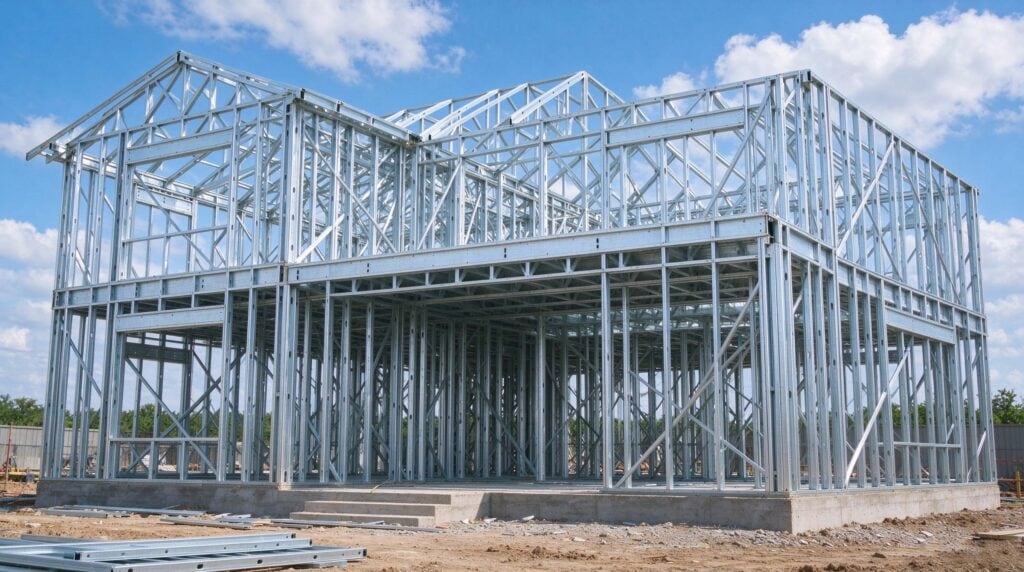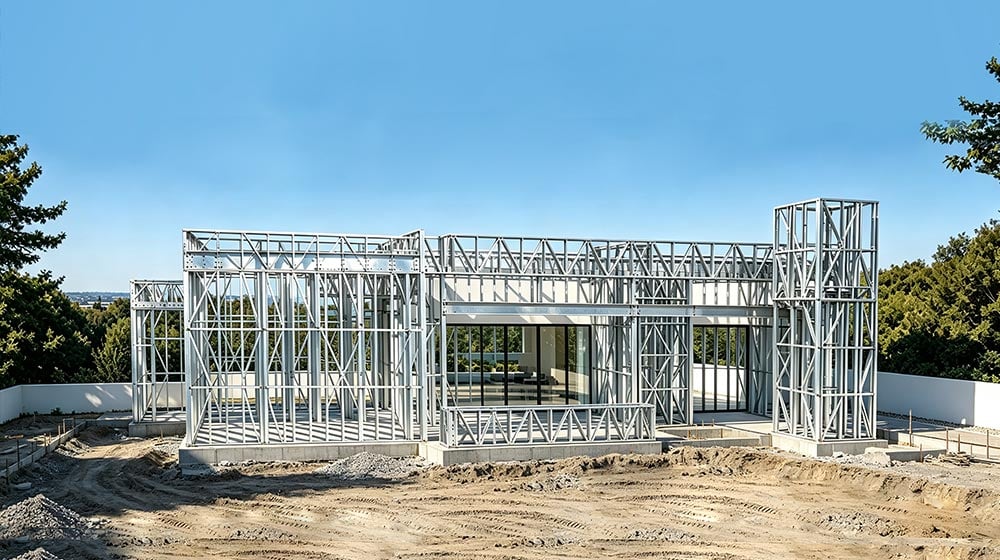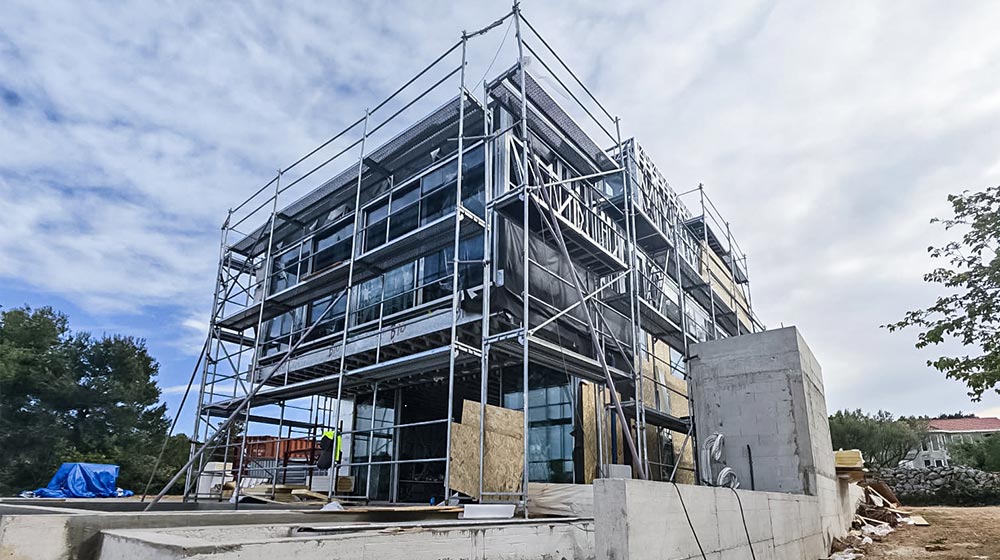
Infrastructure delivery in remote regions has always been a three-front battle: critical housing backlogs stall operations, shipping loose materials across thousands of kilometers of unpaved track destroys budgets, and flying in licensed tradespeople drives mobilization costs to unsustainable levels.
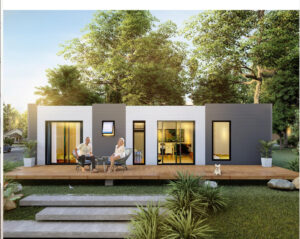
The default response — deploying temporary prefab cabins or container huts — compounds the problem. These stopgap solutions carry high maintenance cycles, poor thermal performance, and generate zero long-term asset value for the organizations funding them. When the contract ends or the project scales, everything gets written off.
There is a better approach. And it starts with rethinking what gets shipped, and how.
Stop Paying to Ship Empty Space
Conventional volumetric modular construction has a fundamental logistics problem: you are shipping air.
Every hollow box that moves down a highway requires oversized load permits, specialized heavy-transport convoys, and road access that many remote sites simply cannot accommodate. The further the site, the more punishing the economics.
The DEEPBLUE Deployable Building System™ was engineered to eliminate this inefficiency entirely.
Rather than shipping a rigid, finished module, the complete building structure — external and internal wall systems, floor structure, and all connection assemblies — is pre-integrated under factory-controlled conditions into a compact, foldable configuration that fits inside a standard 40HQ shipping container.
The result is a system that combines the shipping economics of a kitset with the onsite speed of volumetric modular construction — without the trade-offs of either.
| System | Shipping Cost | Onsite Labor |
|---|---|---|
| Kitset | Low | High |
| Volumetric Modular | High | Low |
| DEEPBLUE Deployable System™ | Low | Low |
The Engineering Behind the Fold
Compressing a permanent building into a standard freight envelope requires precision folding geometry, not simply collapsing panels flat.
The DEEPBLUE Deployable Building System™ uses a coordinated multi-axis folding sequence:
Step 1 — X-Wall Folding: The X-direction wall panels rotate inward toward the Y-direction walls, reducing overall module width and consolidating internal structural volume.
Step 2 — W-Shape Floor Activation: The deployable floor platform — divided into a four-segment or six-segment configuration depending on module size — folds upward simultaneously at its central segments, creating a W-shaped folding geometry. This synchronized movement drives the Y-direction external walls inward and consolidates internal wall assemblies toward the centre.
Step 3 — Volumetric Consolidation: The entire structure compresses into a compact, containerized rectangular transport volume.
Critically, the folded module is not merely a structural shell in transit. Prefabricated steel roof trusses, purlins, insulation batts, and internal finishing components are loaded and secured inside the folded structure during shipping — maximizing container utilization and eliminating separate material consignments.
Permanent Performance. Not a Temporary Compromise.
The question every structural engineer, compliance officer, and institutional procurement team asks is legitimate: can a building that folds and unfolds genuinely perform as a permanent asset?
The answer is yes — and the engineering principle is straightforward.
The deployable hinge assemblies serve one purpose only: logistics and installation movement. They are explicitly excluded from the permanent structural load path. Once the module is positioned and unfolded onsite, the deployment sequence transitions immediately into permanent structural locking:
- Certified mechanical locking systems are activated
- High-strength bolted connections and engineered steel locking assemblies are engaged
- All hinge movement zones are structurally bypassed or permanently fixed
- The continuous Cold-Formed Light Gauge Steel Framing (LGSF) structural loop takes over completely
From this point forward, the building behaves as a conventional fixed-site permanent structure. All vertical loads, lateral forces, seismic forces, wind loads, floor loads, and roof loads transfer directly through the primary LGSF system to the foundation. The deployable mechanism has no role in normal building operation.
This is structural equivalency — not a compromise.
Built for the Conditions That Break Other Systems
The DEEPBLUE Deployable Building System™ is not a general-purpose product. It is an engineered response to the specific conditions that make remote infrastructure delivery expensive, slow, and structurally compromised.
Reduced dependency on skilled site labor. Approximately 90% of structural fabrication, weather barrier installation, insulation integration, and MEP rough-in is completed in a CNC-driven factory environment before the module leaves the factory. Onsite deployment can be executed by local crews using a standard light crane — no specialist trade mobilization required.
Engineered for extreme conditions. The LGSF structural core is designed to project-specific regional requirements. The system can be engineered to withstand wind speeds of up to 350 km/h, making it suitable for cyclone and hurricane-prone regions. Enhanced structural ductility makes it appropriate for active seismic zones. Fire Resistance Ratings of up to 120 minutes FRR are achievable depending on wall assembly and board specification.
Cost and schedule certainty. Moving 90% of construction activity into a controlled factory environment eliminates the primary sources of cost overrun in remote project delivery: weather delays, material damage in transit, skilled labor shortages, and onsite rework. Project directors get a defined delivery timeline and a predictable cost structure — both of which are extremely difficult to achieve with conventional field construction in isolated regions.
The Strategic Case for Industrialized MMC
Organizations managing remote infrastructure — whether mining operators, government housing agencies, resort developers, or institutional accommodation providers — consistently underinvest in the permanence of their remote assets because the logistics cost of conventional construction appears prohibitive.
The DEEPBLUE Deployable Building System™ changes that calculation.
By combining factory-grade build quality, containerized logistics efficiency, and permanent structural engineering performance, the system enables project developers to deploy code-compliant, long-life building assets at the speed and cost structure previously only available for temporary accommodation.
Remote housing does not have to be a disposable expense. With the right industrialized system, it becomes a permanent asset — delivered on time, within budget, and built to last.
DEEPBLUE SMARTHOUSE is a global industrialized building system provider with over 17 years of international project experience, delivering building solutions to more than 50 countries. For project enquiries, contact: [email protected]