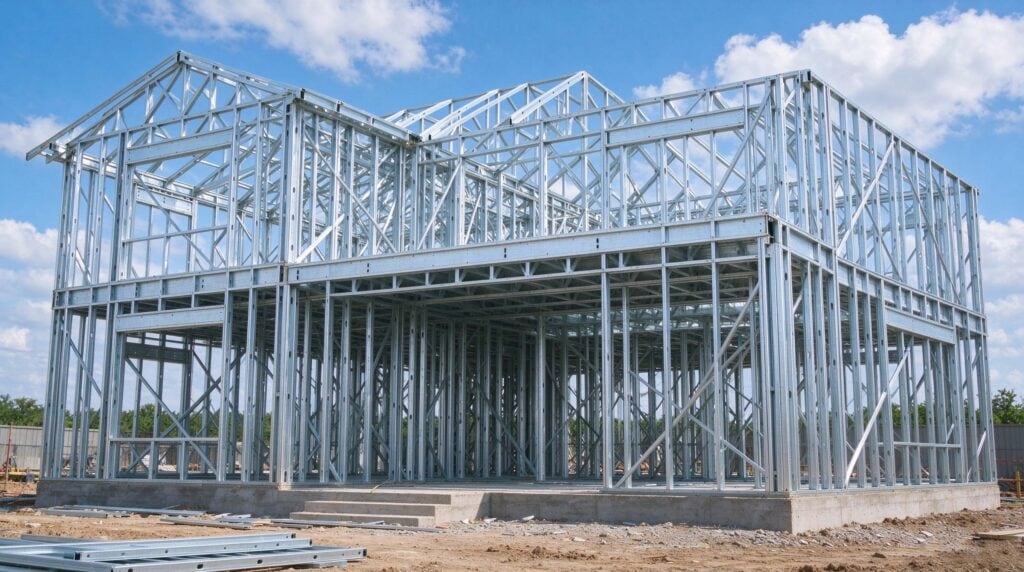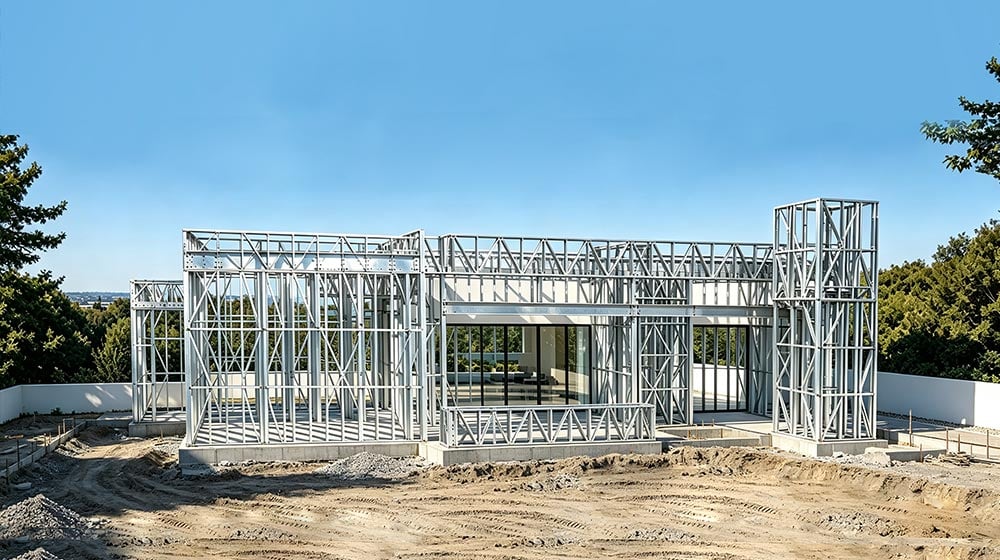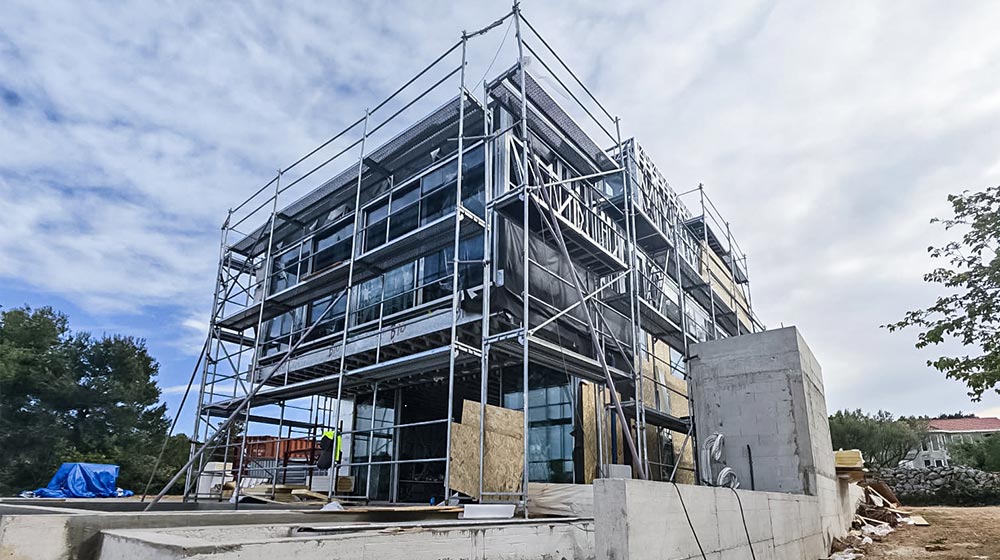
A foldable house is a factory-manufactured prefabricated building engineered to collapse into a compact transport geometry, ship inside a standard 40HQ container, and unfold onsite into a permanently locked structural building. Unlike temporary folding shelters, a permanent foldable house transfers all vertical, lateral, wind, and seismic loads through an engineered Light Gauge Steel Frame (LGSF) system into the foundation — not through the folding mechanism itself.
Published by DEEPBLUE SMARTHOUSE | Ningbo DeepBlue Smarthouse Co., Ltd. | Updated June 2026
Quick Answer: What Makes a Foldable House “Permanent”?
A foldable house becomes a permanent building when:
- The deployed structure is locked with certified high-strength bolted or welded structural connections
- Load transfer occurs through the LGSF frame — not through hinges or folding hardware
- The building meets project-specific code requirements for wind load, seismic resistance, fire rating, insulation, and energy performance
- The foundation, floor, wall, and roof assembly meets the same standards as a conventional permanent building
The folding mechanism serves one purpose only: logistics efficiency during transport and installation. After locking, it plays no structural role.
Why Foldable Houses Matter in 2026
Global construction is under simultaneous pressure from four directions: rising labor costs, longer delivery timelines, higher logistics complexity for remote and international projects, and growing demand for affordable, fast-delivery housing from governments and developers.
The three most common prefab solutions each have limitations:
| Solution | Speed | Shipping Efficiency | Building Quality | Layout Flexibility |
|---|---|---|---|---|
| Traditional Modular (Volumetric) | Fast | Poor (large volume per unit) | High | Limited |
| Container House | Medium | Good | Low–Medium | Very limited |
| Panelized / Kitset | Slow (site assembly) | Good | Medium–High | High |
| LGSF Deployable (Foldable) | Fast | Excellent | High | High |
The DEEPBLUE Deployable Building System™ was developed to occupy this fourth position: the combination of fast onsite deployment, efficient container shipping, high structural performance, and genuine layout flexibility.
How the DEEPBLUE Deployable Building System™ Works
The system follows a six-stage production and deployment logic:
Stage 1 — BIM Design Coordination Each project is designed using BIM (Building Information Modeling), coordinating the structural frame, wall systems, MEP routes, roof geometry, and folding sequence. CNC roll-forming ensures manufacturing precision.
Stage 2 — Factory Pre-Assembly The LGSF frame, wall panels, floor system, windows, and doors are factory pre-integrated. Interior finishes, insulation, and MEP components can be pre-installed depending on project specifications.
Stage 3 — Compact Folding for Shipping The building is folded into a geometry compatible with a standard 40HQ shipping container. Additional materials — roof trusses, cladding, insulation, MEP components — are packed inside the folded unit, maximizing container utilization.
Stage 4 — Onsite Positioning and Unfolding The folded module is delivered to site, crane-lifted to the prepared foundation, positioned, and unfolded in a controlled sequence.
Stage 5 — Structural Locking Once unfolded and aligned, the building is locked using engineered structural connections: high-strength bolts, welded plates, locking assemblies, wall-to-floor and wall-to-roof fixed connections, and structural bracing elements. After this stage, the building behaves as a fixed permanent structure.
Stage 6 — Completion and Handover Roof installation, external cladding and waterproofing, MEP connection, interior finishing, and final inspection are completed. The sequence can be adjusted based on the balance between factory completion and onsite labor availability.
W-Shape Folding Geometry: The Engineering Logic
The DEEPBLUE system uses a controlled W-shape folding geometry that allows a larger building footprint to be compressed into a shippable module without dismantling the core structure.
Wall Folding: X-direction wall panels rotate inward toward Y-direction walls, collapsing the building envelope without removing structural members.
Floor Folding: The floor system uses a four-segment or six-segment configuration. Central floor sections rotate upward in a synchronized motion, forming the W-shaped geometry. This allows a floor area significantly larger than the container footprint to be compressed into transport dimensions.
Rigid Perimeter Zone: A fixed structural zone is maintained around the perimeter wall areas throughout folding, transport, lifting, and deployment. This maintains dimensional stability and protects the structural members during logistics handling.
Technical Specifications
| Parameter | Specification |
|---|---|
| Structural System | Light Gauge Steel Frame (LGSF) |
| Manufacturing Method | BIM-coordinated, CNC roll-formed |
| Transport Format | 40HQ container-compatible folded geometry |
| Foundation Type | Concrete slab, strip footing, screw pile, or raised platform (project-specific) |
| Wind Resistance | Project-specific engineering per local code |
| Seismic Performance | Project-specific engineering per local code |
| Fire Rating | Adaptable — project-specific assembly selection |
| Insulation Options | EPS, rock wool, PIR, spray foam, or composite systems |
| Acoustic Performance | Project-specific — wall and floor assembly dependent |
| Applicable Codes | IBC/ICC, AS/NZS, Eurocode, UK Building Regulations, and others |
| Stories | Single-storey standard; multi-storey with project engineering |
| Finish Options | Wide range — from standard to high-end hospitality grade |
Final specifications depend on building location, local code requirements, wind zone, seismic zone, energy performance targets, and project scope.
Foldable House vs Container House: Key Differences
These are frequently confused but are fundamentally different product categories.
| Comparison Point | Container House | LGSF Foldable House |
|---|---|---|
| Structural origin | Repurposed cargo box | Purpose-designed building system |
| Internal layout | Fixed by container dimensions | Flexible, customizable |
| Insulation | Difficult (thermal bridging) | Full insulation system integration |
| Fire rating | Limited | Fully adaptable |
| Acoustic performance | Poor | Engineered |
| Ceiling height | Constrained | Standard or custom |
| Architectural value | Low–Medium | Medium–High |
| Shipping efficiency | Good | Excellent |
| Code compliance | Challenging | Achievable with engineering |
| Long-term building use | Acceptable for basic use | Suitable for permanent residential, commercial, hospitality |
Summary: A container house is a product repurposed from logistics infrastructure. A foldable LGSF building is an engineered construction system purpose-built for permanent use.
Foldable House vs Traditional Volumetric Modular Building
| Comparison Point | Volumetric Modular | LGSF Foldable / Deployable |
|---|---|---|
| Factory completion | High | Medium–High |
| Shipping volume per unit | Large | Compact |
| International logistics cost | High | Significantly lower |
| Onsite installation speed | Fast | Fast |
| Layout flexibility | Moderate | High |
| Best suited for | Domestic projects with short haul | International, remote, or island projects |
| Multi-storey capability | Yes | Yes (with project engineering) |
For international projects where ocean freight is a major cost component, the deployable LGSF format provides a strong commercial advantage over conventional volumetric modular buildings.
Best Applications for Permanent Foldable Buildings
The DEEPBLUE Deployable Building System™ is particularly well-suited for:
Government and Institutional Projects
- Affordable housing programs
- Emergency and transitional housing
- Military and defense accommodation
- Disaster recovery and reconstruction housing
Workforce and Remote Site Accommodation
- Mining, energy, and infrastructure camps
- Remote site worker dormitories
- Island and coastal projects
Hospitality and Tourism
- Resort villas and glamping cabins
- Holiday parks and eco-resorts
- Boutique hotels and hospitality compounds
Residential Development
- Build-to-rent communities
- Student housing
- Granny flats and secondary dwellings
- Multi-unit residential developments
Common project characteristics: International shipping required, tight delivery schedule, repeatable unit design, remote or infrastructure-limited site, or high labor cost environment.
Is a Foldable House Cheaper Than Traditional Construction?
Cost depends on project scale, location, specification, and scope definition. As a general framework:
Where foldable LGSF buildings provide cost advantages:
- Reduced onsite labor time and risk
- Reduced weather dependency during construction
- Lower logistics cost compared with volumetric modular shipping (especially for international projects)
- Faster project completion and earlier revenue generation
- Repeatable unit design reduces engineering and coordination cost per unit at scale
Where costs remain significant:
- Factory manufacturing cost
- International freight and customs
- Foundation preparation
- Local MEP connection
- Crane and site logistics
For serious project budgeting: Indicative pricing requires drawings, specifications, building location, applicable codes, wind and seismic zone, insulation and fire rating requirements, delivery terms, and scope of supply. Projects above 20 units typically achieve the most commercially viable cost-per-unit outcomes.
Frequently Asked Questions
What is a foldable house? A foldable house is a factory-manufactured prefabricated building engineered to collapse into a compact transport form — typically fitting inside a standard 40HQ shipping container — and unfold onsite into a permanently locked structural building. The folding mechanism is used only for transport and installation. After deployment and structural locking, a permanent foldable house transfers all building loads through its engineered frame to the foundation.
Is a foldable house a real permanent building? Yes, when properly engineered. A foldable house becomes a permanent building when its structural connections are locked after deployment and the building frame — not the folding hardware — carries all vertical, lateral, wind, and seismic loads to the foundation. The DEEPBLUE Deployable Building System™ is designed on this principle.
How long does it take to install a foldable house? Installation speed depends on foundation readiness, building size, crane availability, and local labor conditions. Compared with traditional construction, the onsite installation phase is significantly shorter because the main structure is factory pre-integrated. For multi-unit projects, the repeatable deployment sequence further improves installation efficiency.
Can foldable houses be stacked or combined into larger buildings? Yes. Multiple modules can be connected horizontally to create larger floor plans including villas, resorts, offices, schools, and medical buildings. With project-specific structural engineering, multi-storey configurations are also achievable for apartments, student housing, and hotels.
What building codes can foldable houses meet? Foldable LGSF buildings can be engineered to meet IBC/ICC (United States), AS/NZS (Australia and New Zealand), Eurocode (Europe), UK Building Regulations, and other national codes, depending on site conditions, wind zone, seismic zone, fire rating requirements, and energy performance targets. Local engineer involvement is required for code submissions and permit approvals.
What is the difference between a foldable house and a container house? A container house is based on a repurposed shipping container structure, which constrains layout, insulation options, ceiling height, and code compliance. A foldable LGSF house is purpose-designed as a building system with engineered insulation integration, flexible layout options, fire-rated assembly options, and better architectural adaptability for permanent use.
Who manufactures foldable houses? DEEPBLUE SMARTHOUSE (Ningbo DeepBlue Smarthouse Co., Ltd.) is a manufacturer of permanent LGSF deployable building systems with 17 years of international project experience, exports to more than 50 countries, and over 10,000 homes delivered globally. The company holds ICC-ES certification for the United States market and conducts annual factory inspections through ICC-NTA.
What projects is the DEEPBLUE foldable system best suited for? The system is best suited for government housing programs, resort and hospitality development, workforce and remote site accommodation, disaster recovery housing, student housing, and multi-unit residential development — particularly for international projects where ocean freight cost, onsite labor availability, and delivery speed are key project constraints.
About the DEEPBLUE Deployable Building System™
The DEEPBLUE Deployable Building System™ is a permanent LGSF deployable building platform developed by Ningbo DeepBlue Smarthouse Co., Ltd., a Chinese manufacturer with 17 years of international project experience, exports to more than 50 countries, and over 10,000 homes delivered globally.
The system bridges the gap between panelized construction, volumetric modular buildings, and container-based structures — providing international developers, governments, and hospitality operators with a faster, more logistics-efficient alternative to conventional prefabrication.
Key credentials:
- ICC-ES certification (United States market)
- Annual ICC-NTA factory inspection
- BIM/CNC manufacturing
- 50+ export countries
- 10,000+ homes delivered
Contact DEEPBLUE SMARTHOUSE to discuss your project requirements, structural certification needs, delivery timeline, and technical specifications.
👉 Discuss Your Project with DEEPBLUE